In the ever-evolving world of fitness, enthusiasts and professionals alike are constantly seeking innovative ways to integrate movement into daily life. One such practice that has been gaining traction is the art of navigating through the narrow gaps between bookshelves using a lateral lunge motion. This might sound peculiar at first glance—a niche activity perhaps, born out of necessity or spontaneity. However, delve a little deeper, and you uncover a fascinating blend of functional movement, spatial awareness, and almost meditative focus. It’s not just about squeezing through a tight space; it’s about redefining how we interact with our environment and our own bodies.
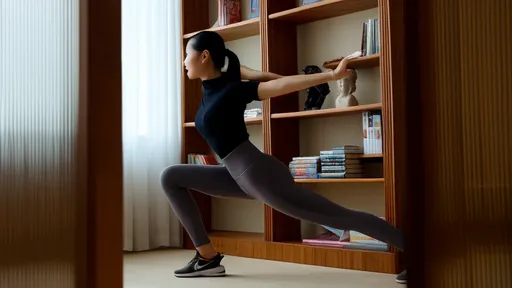
The concept itself is straightforward: using the lateral lunge, a fundamental movement pattern in fitness, to traverse the gaps between shelves. A lateral lunge involves stepping sideways into a wide stance, bending one knee while keeping the other leg straight, and then pushing off to return to the starting position or transition into the next movement. When applied to the confined spaces between bookshelves, this movement becomes a deliberate and controlled exercise in precision. The shelves act as natural boundaries, forcing the practitioner to maintain form and control to avoid collisions. It transforms an ordinary space into an impromptu agility course, challenging both the body and the mind.
What makes this practice particularly intriguing is its accessibility. You don’t need a gym membership, specialized equipment, or even a lot of space. All that’s required is a row of bookshelves with gaps wide enough to accommodate your body moving laterally. For many, this might be a home library, a study room, or even a cozy bookstore corner. The simplicity is deceptive, though. As you begin to practice, you quickly realize the depth of engagement it demands. Your muscles are called upon to stabilize and propel you in a way that typical forward-moving exercises might neglect. The inner and outer thighs, the glutes, the core—all are activated to maintain balance and generate movement in a confined lateral path.
Beyond the physical benefits, there’s a cognitive element to this exercise that shouldn’t be overlooked. Navigating through tight spaces requires sharp spatial awareness and quick decision-making. You must gauge the width of the gap, the placement of your feet, the depth of your lunge, and the swing of your arms—all in a fluid motion. It’s a dance of sorts, one where misjudgment could lead to a bumped elbow or a knocked-over book. This demand for mindfulness turns the exercise into a form of moving meditation. Your attention is wholly absorbed in the present moment, in the subtle adjustments of your body, and in the rhythm of your movement. The clutter of daily thoughts recedes, replaced by a singular focus on the task at hand.
The lateral lunge itself is a powerhouse of functional fitness. It targets the adductors and abductors, muscles that are crucial for stability and mobility in daily activities like walking, climbing stairs, or getting in and out of cars. These muscles are often underworked in traditional workouts that emphasize forward motion, like running or cycling. By incorporating lateral movement, you’re addressing a key plane of motion that enhances overall athleticism and reduces the risk of injury. When performed between bookshelves, the exercise adds an element of constraint that amplifies these benefits. The limited space forces you to control the range of motion, preventing overextension and encouraging proper form. It’s a self-regulating mechanism—the environment itself becomes your coach.
Practitioners of this unique exercise often speak of the joy of discovery it brings. There’s something inherently playful about turning a mundane household item into a piece of fitness equipment. It sparks creativity and encourages a mindset where exercise isn’t confined to a designated hour at the gym but is interwoven into the fabric of daily life. You might start with a single shelf gap, practicing your lateral lunges back and forth, and then gradually string together multiple gaps in a sequence. This progression not only builds endurance and skill but also adds a layer of fun and challenge. It’s a puzzle for the body, each successful pass a small victory.
Of course, safety is a consideration. Before embarking on a bookshelf gap traversal session, it’s important to ensure that the shelves are stable and secure. The last thing you want is to pull a shelf over in the midst of a vigorous lunge. Clear the area of any obstacles on the floor to prevent tripping, and wear comfortable clothing that allows for free movement. Start slowly, focusing on form rather than speed. Feel the stretch in your inner thighs as you sink into the lunge, and engage your core to keep your torso upright. Use your arms for balance, perhaps extending them forward or to the sides. Listen to your body—if you feel any pain beyond the usual muscle stretch, ease off. This exercise should challenge you, not injure you.
As with any fitness practice, consistency yields results. Those who incorporate bookshelf lateral lunges into their routine often report improved agility, better balance, and stronger lower body muscles. But perhaps more surprisingly, many also note an enhanced sense of spatial intelligence. They find themselves more aware of their body’s dimensions and capabilities in other contexts, whether navigating a crowded street or playing sports. This carryover effect underscores the holistic value of the practice. It’s not just exercise; it’s training for life’s physical puzzles.
In a world where fitness trends come and go with the seasons, the simplicity and effectiveness of movements like the lateral lunge through bookshelf gaps have enduring appeal. It harkens back to a time when exercise was not a segregated activity but a natural part of human movement and exploration. It requires no financial investment, only curiosity and a willingness to see familiar spaces in new ways. So the next time you find yourself in a room with bookshelves, take a moment to eye the gaps between them. They might just be the doorway to a new kind of workout—one that strengthens your body, sharpens your mind, and brings a touch of adventure to your day.

By /Aug 14, 2025
By /Aug 25, 2025
By /Aug 25, 2025
By /Aug 25, 2025
By /Aug 25, 2025
By /Aug 25, 2025
By /Aug 25, 2025
By /Aug 25, 2025
By /Aug 25, 2025

By /Aug 25, 2025
By /Aug 25, 2025
By /Aug 25, 2025
By /Aug 25, 2025

By /Aug 25, 2025
By /Aug 25, 2025

By /Aug 14, 2025
By /Aug 25, 2025
By /Aug 25, 2025
By /Aug 25, 2025

By /Aug 25, 2025
